Internal tools
Purpose-built interfaces for operations, administration, reporting and decision-making.
Software shaped around the work
When off-the-shelf software creates more work than it removes, we build the tool that actually fits.
Start a conversation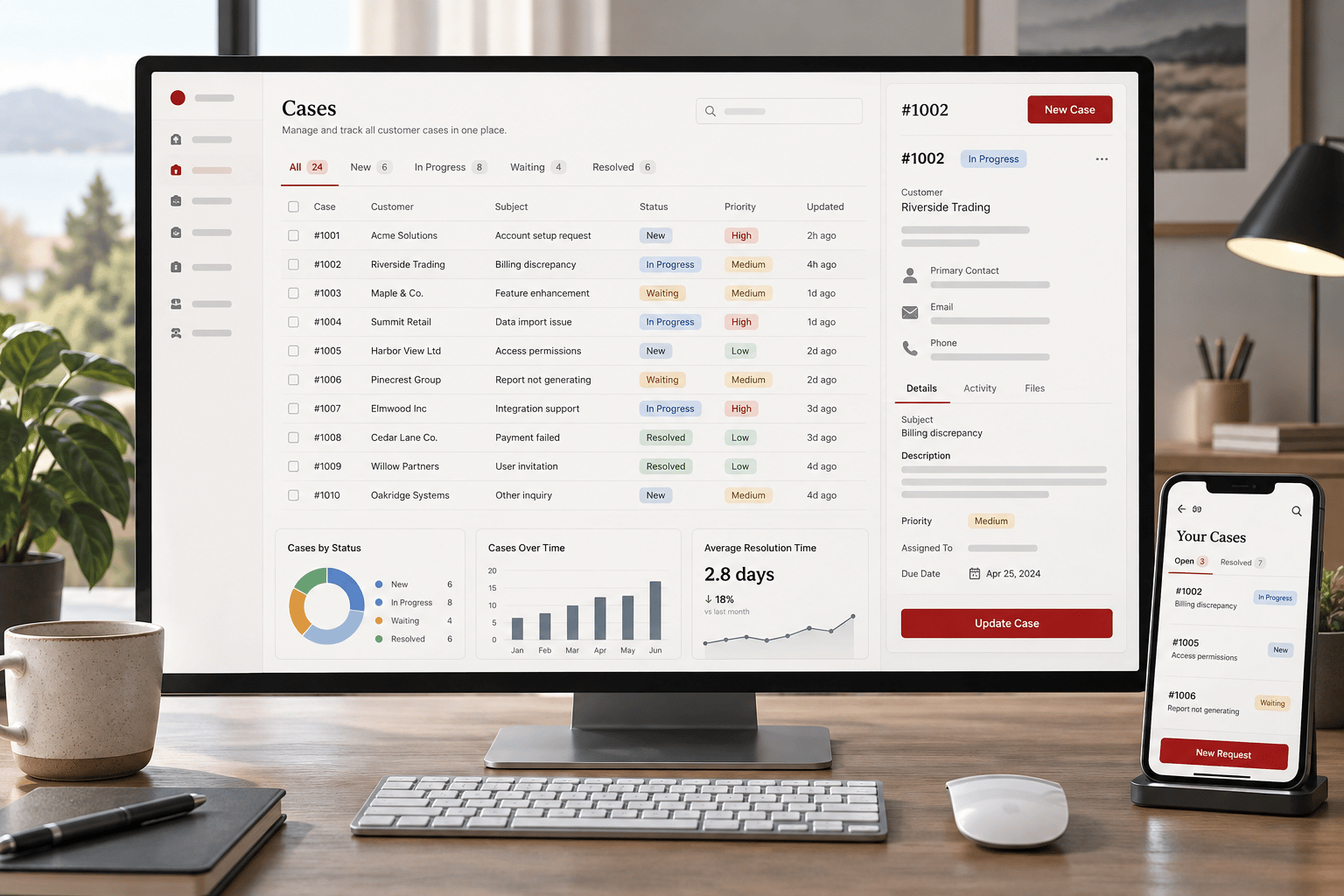
Common project shapes
An idea that needs to exist before it can be judged. Small scope, real users, honest feedback.
Weeks, not quarters
A process that has outgrown spreadsheets and shared inboxes. Built around how the team actually works.
Replaces the workaround
Software that works but is fragile, slow or impossible to extend. Improved in stages, without stopping the business.
No big-bang rewrite
Useful outcomes
Purpose-built interfaces for operations, administration, reporting and decision-making.
Web applications and product foundations that turn an idea into a usable service.
Connect legacy, SaaS and custom systems so information travels without manual repair.
Untangle fragile software and improve it in stages without stopping the business around it.
What is included
Ownership and licensing are made explicit in the proposal. For normal client projects, the objective is clear client ownership without hidden platform lock-in.
It earns its place when a process is genuinely specific, a required rule is missing from available products, or the cost of workarounds has overtaken the cost of owning a focused tool. We compare those options first and will not build custom software unless it is strictly needed. The objective is to solve your problem, not sell you software you do not need.
Yes. A staged improvement is often safer than a rewrite. We identify the risky boundaries, add enough coverage to change them confidently and replace parts only where the evidence supports it.
The first release covers one complete job. Scope, acceptance criteria and deferred ideas stay written down, and anything new is traded against time or budget instead of quietly entering the build.
The handover covers deployment, monitoring, access, data recovery and the decisions future developers need to understand. Ongoing hosting and maintenance are available, but the software is not made dependent on buying them.
Our approach
Good custom software is small and precise. It covers what matters, skips speculative features and runs on boring, proven technology.
In detail
Custom software earns its place when the process is genuinely yours, when no product supports a rule you are not allowed to drop, or when the workarounds have quietly grown more expensive than owning the tool would be. Those cases are real and more common than software vendors like to admit. They are also not every case.
So before quoting a build, we compare it with the cheaper answers: configuring something that already exists, connecting two tools you are both already paying for, or changing the process itself. If one of those wins, we will say so. A project neither of us would be proud of costs us more than a smaller invoice does.
When a build does win, the first version covers one job from beginning to end: the screens, the permissions, and what happens when somebody does the wrong thing. Not a platform for the company you might become.
The requirements are rarely in a document. They are in a spreadsheet with three tabs nobody else opens, an email template, a check somebody performs from memory every Friday, and the reason a colleague always sorts the list a particular way. We work from real cases, especially the awkward ones, because the awkward ones are where the rules live.
Anything uncertain gets prototyped while changing it is still cheap. Scope, what has been deferred and how we will know it worked stay written down where everyone can see them. People respond far better to a screen that resembles their work than to a diagram of it, and that response arrives while there is still time to act on it. What we ask for at the start is mostly evidence:
The application is organised around data you would recognise and rules you could explain out loud. Authentication, authorisation, validation and an audit trail go where the risk sits. Spreading them everywhere by reflex buys nothing. Integrations assume the network fails and that the other side will change without telling you. Backups and restores are designed alongside the deployment, not after the system holds something you cannot afford to lose.
We use technology that is boring on purpose (TypeScript, Node.js, React, PostgreSQL) and leave out infrastructure the project has no use for. A small architecture is easier to test, secure, operate and hand over. Performance work goes into the actions people repeat all day and the volumes you can realistically reach, not the ones on a slide. The real test of the result is whether a competent developer who has never met us can pick it up.
An estimate is a probability, not a promise, and the honest version comes with its assumptions attached. What makes software late is rarely the code. It is a data migration that turns out to be far worse than described, an integration whose documentation is fiction, or a decision that needs three people who are never free in the same week.
So the risky parts get looked at first, while there is still room to change the plan, and scope gets cut before quality does. If something is going to slip, you hear it when we know rather than at the deadline. A smaller first release that actually ships is worth more than a complete one that keeps moving.
New software usually replaces something that cannot pause for a launch. Migration, access, training and rollout are planned as one piece of work. Historical data is cleaned and imported into a rehearsal first, then reconciled against the old source: totals, counts and a sample of records people will recognise. Where the risk is higher, a pilot group runs on both systems for a while.
Deployments are repeatable and carry their own configuration for each environment. Automated checks cover the behaviour that matters, and logging makes a production problem diagnosable instead of reproducible only if you are lucky. People get short instructions for the tasks they actually perform, not a manual. For anything critical there is an agreed way back, so that an ordinary release stays an ordinary release.
Once it is in use, behaviour tells you which assumptions were right. Where people abandon a form, what they ask about, which step is slow, where they have gone back to the spreadsheet anyway. That is a better roadmap than a wish list. An option nobody opens can be removed. One shortcut on a task performed forty times a day is worth more than a feature.
The work that keeps it alive gets planned: dependencies, security updates, backups, and the integrations that change underneath you. Documentation covers how the system runs and the decisions you could not infer from the code.
The source code, the data and the infrastructure accounts are yours, arranged that way from the beginning, so there is nothing to negotiate at the end. Anything provider-specific is named while it is still a choice, so the cost of moving is a number you know instead of one you discover.
If another team takes this over one day, what they need is the repository, the deployment process and documentation that explains the decisions. Those exist. Custom software should give you more control over an important process, not trade one lock-in for another.
We will not build speculative features, rewrite working software for novelty or trap your data behind a platform only we control. Custom software should be small, useful and boring to operate.
Tell us what is slowing you down. You will get a straight answer.